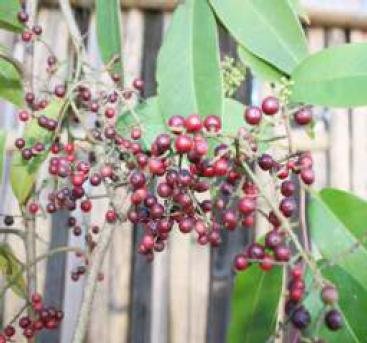
In Ayurveda, Embelia Ribes is considered widely beneficial in a variety of diseases. Its fruits are small reddish-brown to black in color and are found in bunches. The outer covering of fruits is fragile and from inside seeds are spotted. Its fruits are anti-helminthic, and tonic to strengthen and provide energy to the body. It is also used to clear out excess Vata dosha from the intestine. Major chemical compounds reported are Embelin, homoembelin, Christembine, quercitol, vilangine.< br>< br>
< b>Uses:- < b> fever and for chest and skin disease. Paste is applied for skin infection.
| Family | Myrsinaceae | Odour | Characteristic odour |
| Latin Name | EMBELIA RIBES | Herb Extract Ratio | 10:1 |
| Sanskrit Name | Vidanga | Water solubility | Water Soluble Extrac |
| Common Name | VIDANG | Alkaloid | Tannins : NLT 5% |
| Solvent Used | Taste | Bitter in Taste | |
| Storage Condition | Store in a Dry and cool place in double PP bag with container. | Appearance | Brown Powder |
Embelin, volatile oil, fixed oil, resin, tannin, christembine (alkaloid), phenolic acids like caffeic acid, vanillic acid, chrorogenic acid, cinnamic acid, o-cumaric acid
REFERENCES
1 Anon: National Medicinal Plants Board. Ministry of Health and Family, Welfare press releases 2008; 2-5.
2. Anon: The Ayurvedic Pharmacopoeia of India, part I, vol. II. Ministry of Health and Family Welfare, Government of India 1990; 123–124.
3. Ved, Kinhal, Haridasan, Ravikumar, Ghate, Sankar and Indresha: Conservation Assessment and Management Prioritisation for the Medicinal Plants of Arunachal Pradesh, Assam, Meghalaya and Sikkim. Lotus Enterprises Bangalore India 2003.
4. Chopra, Nayar and Chopra: Glossary of Indian medicinal plants. National Institute of Science Communication, CSIR New Delhi, 5th edition, 1999: 106-107.
5. Chopra RN, Chopra IC and Varma BS: Supplement to glossary of Indian medicinal plants. CSIR New Delhi 1969:.27-29.
6. Kapoor V K, Chawla A, Kumar M and Kumar P: Anti-inflammatory agent in Indian Laboratories. Indian Drugs 1983; 30: 481-488.
7. Publication. 1966: 796-799
8. Chitra M, Sukumar E, Suja V and Shyamala Devi CS, Antitumor, anti-inflammatory and analgesic property of embelin a plant product. Chemotherapy 1994; 40:109-122.

Amsar Pvt. Ltd. is a more than 50 years old company banking upon its experience in providing the Medicine and Ayurveda industry quality Ayurvedic Medicines, Herbal Extracts as well as Herbs.


Copyright © 2021 Amsar India Pvt. Ltd. All rights reserved. | Designed by DigiGo Infotech LLP