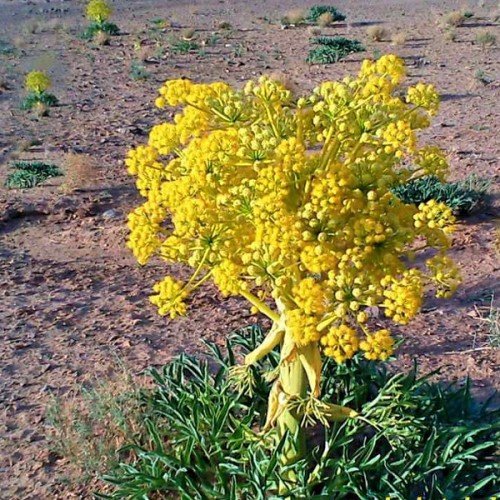
Ferula asafoetida is herbaceous plant of the umbelliferae family. It is oleo gum resin obtained from the rhizome and root of plant. This spice is used as a digestive aid, in food as a condiment and in pickles. It is used in modern herbalism in the treatment of hysteria, some nervous conditions, bronchitis, asthma and whooping cough. It was at one time employed in the treatment of infantile pneumonia and flatulent colic. The gum resin is antispasmodic, carminative, expectorant, laxative, and sedative. The volatile oil in the gum is eliminated through the lungs, making this an excellent treatment for asthma. The odor of asafoetida is imparted to the breath, secretions, flatus, and gastric eructations. Its properties are antispasmodic, expectorant, stimulant, emmenagogue and vermifuge. Asafoetida has also been used as a sedative. It also thins the blood and lowers blood pressure.
Uses:- Asafoetida is used as carminative, expectorant, antispasmodic, and laxative as well as externally to prevent bandage chewing by dogs; for flavoring curries, sauces, and pickles; as an enema for intestinal flatulence, in hysterical and epileptic affections, in cholera, asthma, whooping cough, and chronic bronchitis. This pure Asafoetida gum has certain medicinal uses and is most commonly used as a digestive aid.
| Family | Apiaceae | Odour | Strong garlic-like o |
| Latin Name | Ferula asafoetida | Herb Extract Ratio | 5:1 |
| Sanskrit Name | Ramaha, Badhika | Water solubility | Soluble in alcohol and oils, insoluble in water |
| Common Name | Hing, Asafoetida, Stinking gum | Alkaloid | V. oil - 1.5% | Aseqo : 15% |
| Solvent Used | Water | Taste | characteristic taste |
| Storage Condition | Store in a Dry and cool place in double PP bag with container. | Appearance | Yellowish Brown |
Asafoetida contains volatile oil (4–20%), resin (40–65%), and gum (25%). The garlic-like odour of the oil is due to the presence of sulphur compounds. The main constituent of the oil is isobutyl propanyl disulphide (C6H16S2). The three sulphur compounds, such as, 1-methylpropyl-1-propenyl disulphide, l-(methylthio)-propyl-1-pro-penyl disulphide, and l-methyl-propyl 3-(methylthio)-2-propenyl disulphide have also been isolated from the resin; the latter two have pesticidal properties. The flavour is largely due to R-2-butyl-l-propenyl disulphide and 2-butyl-3-methylthioallyl disulphide (both as mixtures of diastereoisomers).

Amsar Pvt. Ltd. is a more than 50 years old company banking upon its experience in providing the Medicine and Ayurveda industry quality Ayurvedic Medicines, Herbal Extracts as well as Herbs.


Copyright © 2021 Amsar India Pvt. Ltd. All rights reserved. | Designed by DigiGo Infotech LLP