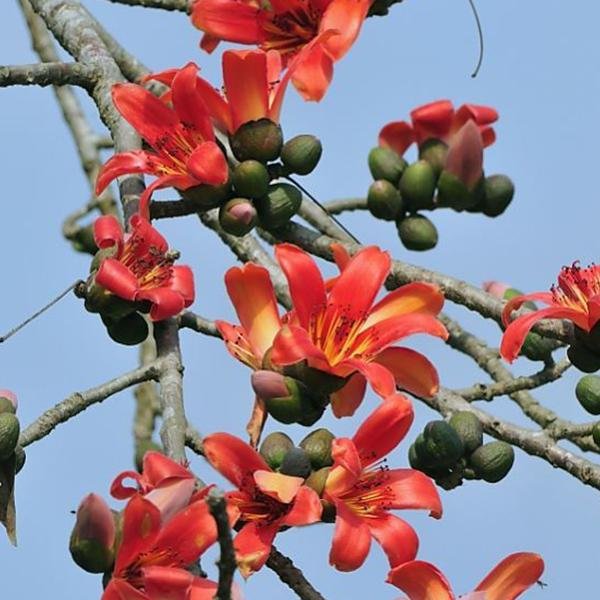
Bombax ceiba, like other trees of the genus Bombax, is commonly known as cotton tree. More specifically, it is sometimes known as Malabar silk-cotton tree; red silk-cotton; red cotton tree; or ambiguously as silk-cotton or kapok,[2] both of which may also refer to Ceiba pentandra.
This Asian tropical tree has a straight tall trunk and its leaves are deciduous in winter. Red flowers with 5 petals appear in the spring before the new foliage.[3] It produces a capsule which, when ripe, contains white fibres like cotton. Its trunk bears spikes to deter attacks by animals. Although its stout trunk suggests that it is useful for timber, its wood is too soft to be very useful.
Uses:- The white fluffy fibres are carded into thread and woven into textiles in Nepal and India. In North India, fibers are also used in pillows. In Thailand, the dry cores of the Bombax ceiba flower are an essential ingredient of the name ngiao spicy noodle soup of the cuisine of Shan State and Northern Thailand,[6] as well as the kaeng khae curry.[7] Its flower buds are known as "Marathi Moggu" are also used in the regional cuisine of Southern India as a spice as well as in herbal medicine.
| Family | Bombacaceae | Odour | Characteristic odour |
| Latin Name | bombax malabaricum | Herb Extract Ratio | 10:1 |
| Sanskrit Name | SALMARI | Water solubility | |
| Common Name | Silk Cotton Tree, Red Kapok Tree | Alkaloid | terpenes, flavonoids, alkaloids |
| Solvent Used | Water | Taste | Sweet |
| Storage Condition | Store in a Dry and cool place in double PP bag with container. | Appearance | Brown Powder |
Phytochemical investigations of Bombacoideae plant species resulted in the extraction and isolation of several classes of secondary metabolites. Among the most studied genera, there are Adansonia, Bombax, and Chorisia [2,37,38]. Bombax ceiba (syn. Bombax malabaricum, Bombax malabarica, Salmalia malabaricum, Gossampinus malabarica), Adansonia digitata, and Chorisia speciosa are the most chemically and biologically investigated species.

Amsar Pvt. Ltd. is a more than 50 years old company banking upon its experience in providing the Medicine and Ayurveda industry quality Ayurvedic Medicines, Herbal Extracts as well as Herbs.


Copyright © 2021 Amsar India Pvt. Ltd. All rights reserved. | Designed by DigiGo Infotech LLP